
Selected work and current portfolio direction
Bowenvale has been involved in many technology, communications, hosting, software, design and business projects over several decades. Rather than trying to list everything, this page now focuses on selected examples that show the current direction of the practice: practical systems, useful integrations, clear presentation of data and rapid AI-assisted development under experienced technical direction.
Some examples are public. Others include private dashboards, administrative tools, backend workflows or sensitive data handling that cannot be fully shown on the open web. Where appropriate, those systems can be demonstrated through curated screenshots, sanitised examples or private walkthroughs.
The common thread: turning a business problem, public dataset, integration requirement or written brief into something people can use, review and improve.
Hero examples
Deafblind Association CRM
deafblind-crm.bowenvale.co.nz/dashboard
A customer relationship and organisational management platform produced for the New Zealand Deafblind Association. The project demonstrates the ability to take a relatively basic brief, hold a small number of stakeholder conversations, and use AI-assisted development to rapidly produce a clean, substantial business application.
The interface was designed to be clear and accessible, reflecting the needs and standards of the organisation. The first working version was turned around in less than 24 hours after two or three short conversations with key stakeholders.
Solar Analytics Platform
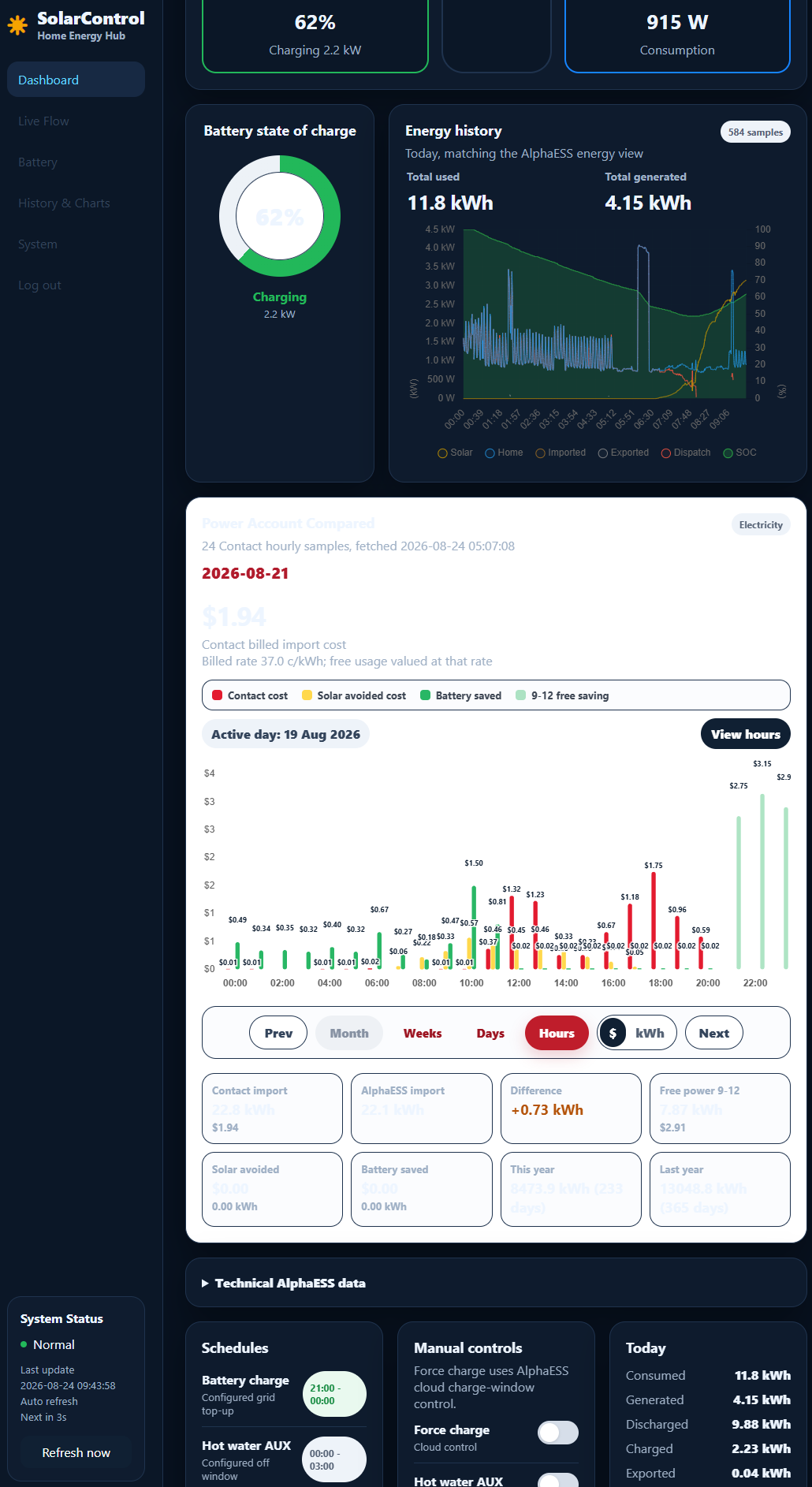
This platform combines data from a solar inverter API with information extracted from an authenticated power-provider website that does not expose the required consumer data through a suitable API. The resulting system brings solar generation, battery behaviour, household consumption and financial information together in one dashboard.
The important architectural point is that the web interface is only one presentation layer. The underlying service approach was designed so future interfaces, including a mobile application or other dashboards, could consume the same data layer. The initial application was produced in approximately 48 hours.
Rates Explorer
Rates Explorer takes large public-authority datasets and presents them as interactive graphical and statistical information for community review. It demonstrates data transformation, statistical processing, PHP implementation, visualisation and iterative refinement based on community feedback.
The core system was developed using AI-assisted prompts and direction, with roughly five days of direct development effort spread across several weeks as additional ideas and questions emerged from the community.
Public data, monitoring and civic systems
CCC Monitor Timeline / Sewer Crisis data work
sewercrisis.nz/ccc-monitor-timeline
This work pulls public environmental monitoring information into a more useful form, preserving history locally, analysing timing and statistical patterns, and presenting the results through public-facing pages and WordPress-integrated tools.
The public page is only part of the story. Some of the more technically useful capability sits behind the scenes in data handling, backend administration, reporting and workflow interfaces.
Community Needs Database
sewercrisis.nz/community-needs
A public-facing data-entry application created to record sensitive community and health-related information. The system was designed with a security-conscious approach and encrypted data storage, recognising that sensitive information requires different treatment from ordinary web content.
Public claims about legal or regulatory compliance should always be made carefully, but the project demonstrates the practical design intent: accessible public input, protected data handling and backend review capability.
Requirements to proof of concept
Council Meetings and Agendas RFI proof of concept
This project is an important example of where AI-assisted development changes the early stages of software delivery. Rather than manually converting a procurement or requirements document into multiple layers of analysis before anything can be seen, a written RFI or high-level brief can be interpreted and translated into a working proof of concept for review.
The application is still a work in progress, but it already demonstrates a valuable pattern: client requirements document to working software to stakeholder review and refinement. That is one of the strongest examples of how modern tools can compress the distance between what a client writes and what a client can test.
Historical capability
Bowenvale’s older work still matters because it explains the depth behind the current AI-assisted approach. Past projects have included telecommunications systems, call billing and analysis tools, document and imaging systems, hosting, networking, technical documentation, digital print, branding, business positioning and small-business support.
Think Design Print is part of that story. It brought together digital printing, design concepts, business identity and commercial presentation for many Christchurch small businesses over many years. That history is one reason Bowenvale’s current website combines technology, visual identity, civic pride and practical business communication rather than presenting technology as a purely abstract discipline.
How projects are selected for publication
The public portfolio should focus on quality rather than volume. The strongest examples are those that show a clear problem, a useful outcome, a visual or technical proof point, and the speed or practicality of the delivery process.
Where a project includes personal, health, credential, client-confidential or commercially sensitive information, it should be sanitised before publication or kept for private demonstration only.
The goal is not to show every project Bowenvale has touched. The goal is to show what experienced technical judgement becomes when modern AI-assisted development removes much of the mechanical delay between idea and working system.